Attic Spray Foam Insulation
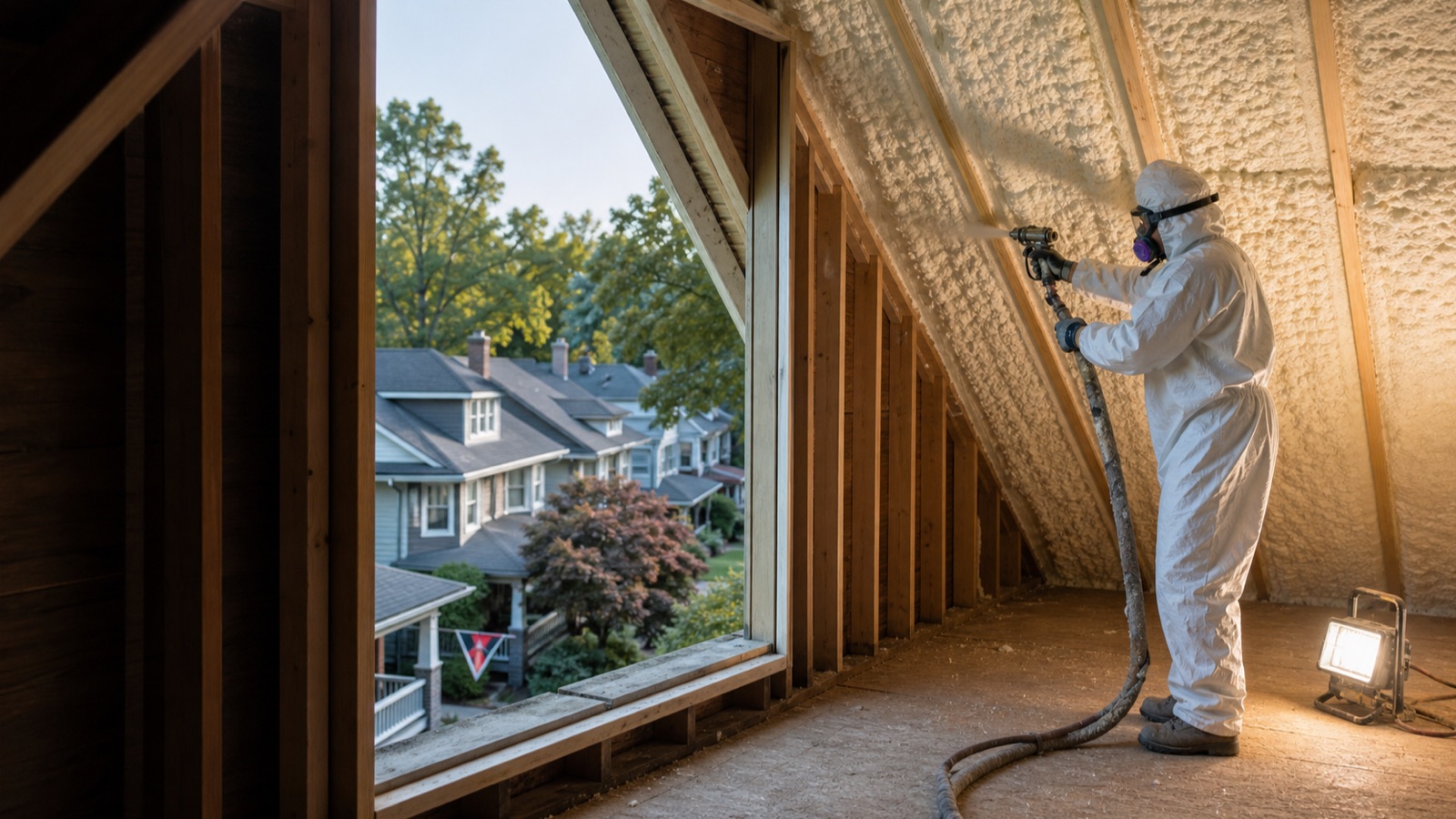
Roof deck or attic floor foam, chosen by where your ductwork lives and built to the Ohio Zone 5A attic value.
Typical$2,800-$8,500
BPI-credentialed spray foam installs across Central Ohio since 2019. Closed-cell, open-cell, and hybrid spray foam for attics, walls, crawl spaces, and rim joists. Most jobs complete in 1-2 days with a manufacturer-stamped closeout package.
Step 1
The Columbus-area installer measures square footage, evaluates access, and writes a fixed-price quote on the same visit.
Step 2
Closed-cell vs. open-cell, attic vs. wall, ventilation strategy, designed around your home and HVAC layout.
Step 3
Crew arrives with truck-mounted spray rig. Most jobs complete in a single day; whole-home retrofits take 2-3.
Step 4
Manufacturer-stamped product data, R-value certification per surface, square footage covered, and itemized invoice for your records and any current state or utility rebate program.
Heating degree days a year the Residential Code of Ohio lists for Columbus, against 4,410 for Cincinnati, so winter air leakage costs more here.
Attic ceiling value the Ohio code sets for new homes and additions in Franklin and the surrounding Climate Zone 5A counties.
Average heating and cooling savings Energy Star estimates for homeowners who seal air leaks and add insulation.
Climate Zone 5A county assignments, insulation values by component, and the 5 ACH50 air leakage test for new homes.
Section 25C credit terminated December 31, 2025 under the One Big Beautiful Bill Act, Public Law 119-21. Background page maintained by IRS for projects placed in service before that date.
Energy Star recommendations for attic and wall insulation R-values by climate zone.
The Building Performance Institute credentials spray foam Columbus installers.
Every job comes with a written quote and no-pressure consultation. Workmanship warranty terms are set by your lead technician and confirmed before work begins.
Roof deck or attic floor foam, chosen by where your ductwork lives and built to the Ohio Zone 5A attic value.
Open-wall foam for new builds and additions, and drilled-in fill for finished walls in older Columbus houses.
Sealed crawl spaces for Central Ohio clay soils: water handled first, then liner, wall foam, and humidity control.
About R-6 to R-7 per inch, a vapor retarder at typical thickness, and rigid enough to stiffen what it bonds to.
About R-3.5 to R-3.8 per inch, vapor-open, and the lower-cost way to fill deep cavities with an air seal.
Pole barns, steel shops, and detached garages: closed-cell on the steel to stop dripping condensation and hold heat.
The band of framing on top of the foundation, sealed and insulated with closed-cell in a half-day job.
We offer $50 off any spray foam insulation project for veterans, active military, first responders, and seniors 65 and older. Mention it when you call or text us.
Mention this offer when you call
(380) 256-3626“Our 1930s cape had a second floor we basically closed off every January. Closed-cell at the roof deck and rim joist over two days, and the upstairs now holds within a few degrees of the thermostat. The January gas bill came in about a third lower than the year before, and the blower-door numbers were all in the closeout folder.”
“We put off drill-and-fill in our 1910s brick-and-plaster house for years because we dreaded the patching. The access holes were plugged and skim-coated so cleanly that guests cannot find them. The blower-door retest showed roughly half the leakage of the first test, and the street noise is noticeably duller.”
“Whole-home foam on our new build, worked in around the framers and the HVAC rough-in without slipping the schedule. The final blower-door came in under 2 ACH50, tight enough that the builder downsized the furnace and AC a full size. The closeout package went straight into our build binder.”
These reflect real situations from homeowners across our network. Names and some identifying details are adjusted to protect homeowner privacy while keeping the point of each story intact.



The Residential Code of Ohio places Franklin, Delaware, Licking, Fairfield, Union, Madison, and Pickaway counties in Climate Zone 5A, one zone colder than Hamilton County on the Ohio River. Its design table lists 5,660 heating degree days a year for Columbus, and that long heating season is why winter air leakage, more than summer heat, drives most of the savings here. Zone 5 also changes real requirements: floors over unconditioned space rise to R-30, masonry walls need more insulation, and an unvented roof insulated with foam must meet a stricter condensation rule than it would in Zone 4.
The houses matter as much as the climate. Columbus has solid brick from the 1800s in German Village and Olde Towne East, balloon-framed houses near the university and in Victorian Village, period revival homes in Upper Arlington and Bexley, postwar ranches in Whitehall and Reynoldsburg, and large 1990s-to-2020s subdivisions across Delaware County. Each type leaks in its own predictable places, and each needs its own plan.
The ground matters too. Much of the region sits on slow-draining glacial till, so basements and crawl spaces see spring water that has to be handled before anything is sealed. Spray foam is one tool in that plan: the right one at rim joists, crawl walls, steel buildings, and roof decks over ductwork, and often not the cheapest answer on a wide-open attic floor.
Start by finding the leaks rather than choosing a product. A blower door test and a thermal camera on a cold morning show where air moves, and in most Central Ohio houses built before the late 1990s the answer begins in two places: the basement rim joist, the band of framing on top of the foundation, and the attic floor, where top plates, chases, light boxes, and the hatch open into the attic.
Sealing those two is usually the best return in the house. A rim joist job typically runs $800-$2,200 and takes about half a day. Attic work generally runs $2,800-$8,500, depending on whether the floor is sealed and topped up or the roof deck is insulated because ductwork lives up there.
After that, the house decides the next step. A damp crawl space under a family room, a cold bonus room over a garage, or empty walls in a 1920s frame house each move to the top of the list in the houses that have them. Envelope work across several surfaces generally runs $12,000-$22,000. A second blower door test after each phase shows what changed and guides the next decision. The where to start FAQ explains the order in more detail.
Four sets of rules show up on nearly every job. For fire, section 316 of the Residential Code of Ohio separates foam from living space with a thermal barrier such as half-inch drywall, allows an ignition barrier or tested coating in attics and crawl spaces entered only for service, and lets rim joist foam up to 3-1/4 inches stay uncovered when it meets density and fire-test limits. For roofs, section 806.5 allows unvented attics, and in Zone 5 it requires the foam to be a Class II vapor retarder or be coated, plus at least R-20 of foam at the deck when batts go underneath. For crawl spaces, section 1102.2.11 requires a sealed Class I vapor retarder over the soil when the walls are insulated instead of the floor. For air, new homes must test at or below 5 ACH50, and whole-house mechanical ventilation is mandatory.
Products and people matter too. Every foam used should carry a current ICC-ES evaluation report, and every install is performed by a BPI-credentialed contractor who can test the house before and after and check combustion safety. The Zone 5A targets table lists the numbers component by component.
The paperwork outlasts the work day by decades. Expect a dated invoice listing each surface with its area, foam type, thickness, and board feet; the product data sheet and ICC-ES report number; the barrier used over the foam; photos of the bare surfaces before spraying, including moisture readings on roof decks and rim joists; blower door numbers before and after when air sealing was part of the scope; and the written workmanship warranty.
That folder answers the questions a home inspector, appraiser, insurer, or roofer will ask later, and it tells whoever sizes your next furnace what the house really needs. It also keeps you ready if a new incentive appears. The federal Section 25C credit ended for work placed in service after December 31, 2025, and in 2026 the remaining help in Central Ohio is income-qualified, through Columbia Gas WarmChoice, the AEP Ohio HELP program, and the state weatherization program. See what documents to expect for the full list.
Greater Columbus and Central Ohio and surrounding communities. Same-day estimates within 27+ neighborhoods.
Most Columbus and Central Ohio homeowners get a fixed-price spray foam quote within the same business day. Every install is performed by a BPI-credentialed local crew using Demilec, Icynene, and BASF closed-cell and open-cell foam, with a manufacturer-stamped closeout package.
Browse all 58 questions for more depth.
Most Central Ohio jobs are priced by the board foot: roughly $1.50-$2.50 for closed-cell and $0.50-$1.20 for open-cell. A basement rim joist runs $800-$2,200, an attic $2,800-$8,500, and a whole-house envelope $12,000-$22,000.
Three things move a Columbus number more than anything else. First, which surface: the band joist in a Whitehall ranch basement is a few hundred board feet, while the underside of the roof deck on a Dublin two-story with a bonus room can run to several thousand. Second, which foam: closed-cell costs roughly twice as much per board foot but delivers about twice the R-value per inch, so the gap narrows wherever depth is limited. Third, prep: pulling decades of loose fill out of an Upper Arlington attic, installing baffles, or opening a knee wall is priced separately from the spray itself. A written quote should state board feet, thickness, and product for each surface so two bids can be compared line by line. The quote comparison checklist walks through that, and the calculator gives a first range before anyone visits.
Per inch, closed-cell foam delivers about R-6 to R-7, open-cell about R-3.5 to R-3.8, blown cellulose about R-3.2 to R-3.8, and fiberglass batts roughly R-3 to R-3.7. The bigger difference is that foam also stops air, which batts and loose fill do not.
The number printed on a bag measures conductive heat flow through the material in a lab with no air moving through it. Houses do not behave that way. Air slips around the edges of batts, through the gaps at wires and pipes, and straight through loose fill that has not been dense-packed, and in a Columbus winter that moving air carries heat out faster than conduction does. Spray foam bonds to the framing and sheathing and fills those gaps as it expands, so the rated R-value and the delivered R-value stay close together. That matters most where space is tight and air pressure is high: a 2x4 wall, the band joist above a basement, a knee wall behind a bonus room, a cathedral ceiling framed with 2x8 rafters. In a wide-open attic with room for 16 inches of material, blown cellulose over an air-sealed ceiling reaches the Ohio code value of R-49 for less money, which is why the right answer is usually a mix rather than one product.
Not federally. The Section 25C credit for insulation and air sealing ended for work placed in service after December 31, 2025. In Central Ohio the help left in 2026 is income-qualified: Columbia Gas WarmChoice, AEP Ohio HELP, and the state weatherization program.
The IRS treats a home improvement as placed in service when the original installation is completed, so a job that wrapped up in January 2026 does not qualify even if it was signed and paid for in 2025. For 2026 and later work, the money-back paths in Franklin, Delaware, Licking, Fairfield, and Union counties are narrow. Columbia Gas of Ohio has ended its general residential efficiency programs but still offers no-cost weatherization through WarmChoice for customers at or below 200 percent of the Federal Poverty Guidelines. AEP Ohio runs the High Efficiency for Low-income Program for households at or below 300 percent of the guidelines, though it paused applications for 2026 and plans to reopen them for 2027 program assistance. The Home Weatherization Assistance Program, applied for through energyhelp.ohio.gov or a local community action agency, also uses the 200 percent line. Keep an itemized invoice regardless; if a future credit appears, that paperwork is what qualifies you. Each program is broken down in utility help for Columbus insulation.
Cured polyurethane foam does not settle, slump, or lose its shape, so a correct install lasts as long as the framing it is bonded to. What shortens its life is sunlight, repeated wetting, or a bad install, not age.
Foam is a thermoset plastic: once the two components react, the result does not soften or break back down at household temperatures. That turns the lifespan question into a question about the conditions around it. Exposed to ultraviolet light, the surface yellows and crumbles over time, which is why exterior foam needs a coating and why foam left bare near a sunny pole barn gable or skylight should be covered. Soaked again and again by a roof leak or a wet crawl space, open-cell foam holds water against the wood it touches. Foam mixed off-ratio never finishes curing, which is a day-one defect rather than an aging problem. In Central Ohio the practical long-term threats are a roof that starts leaking years later above an unvented deck and a crawl space whose drainage fails; both are maintenance items, not foam failures. Material warranties and workmanship warranties are separate documents, and both belong in the closeout package.
It depends on where the house starts. Energy Star estimates sealing and insulating saves an average 15 percent on heating and cooling. Drafty pre-war Columbus homes often beat that; a newer house already built to the Ohio blower door limit usually saves less.
The Energy Star figure comes from modeling a typical 1970s or 1980s house with about a quarter of its air leakage sealed and insulation brought up to a modern code level, averaged across the country. Central Ohio pushes that number both ways. The Residential Code of Ohio design table lists about 5,660 heating degree days a year for Columbus against 4,410 for Cincinnati, so winter air leakage costs more here, and a drafty Clintonville foursquare or a Whitehall ranch with a bare rim joist tends to land above the average. A house built under the 2019 Residential Code of Ohio already had to test at or below 5 air changes per hour at 50 pascals, so it has less to gain. The honest way to estimate your own savings is to compare 12 months of Columbia Gas and AEP Ohio usage (therms and kilowatt-hours, not dollars) and a blower door number before and after the work. The diagnosis tool helps you read the symptoms first.
A basement rim joist is usually a half day and a typical attic one day. Walls, crawl spaces, and jobs covering several surfaces run two to three days, plus any removal of old insulation beforehand and a cure period before anyone moves back in.
The spraying is the quick part. Setting up the truck-mounted proportioner, masking, and bringing the drums to temperature take the first hour or two, and closed-cell goes on in passes with a pause between them so heat from the reaction does not build up. Removing old insulation, which is common in Upper Arlington and Clintonville attics filled with decades of loose fill, is often a separate day. Winter adds time in Central Ohio: an unheated attic or crawl space on a January morning can sit below the product minimum surface temperature, so the space is warmed first instead of sprayed on schedule with a poor cure as the result. Plan for the household to be out of the home during spraying and for the manufacturer re-entry window afterward, commonly 24 hours. See staying home during the install for the details.
Plan to be out. People and pets should leave during spraying and stay away for the manufacturer re-entry period, commonly around 24 hours for residential work, while the space is ventilated.
The concern during application is airborne isocyanate, which OSHA identifies as a cause of occupational asthma and of eye, nose, throat, and skin irritation. Applicators wear respiratory protection for that reason; occupants have none, so the practical rule is simple: leave, and come back only after the written re-entry time for that specific product has passed with ventilation running. For a rim joist job in a Worthington basement, many households plan to be away for the day and the night. For a full attic, or a crawl space connected to the air handler, the heating and cooling system is usually shut down and its openings sealed during spraying so it cannot pull vapor through the house. Ask for the re-entry time in writing before the job and ask how the space will be ventilated. A fishy odor that lingers after the re-entry window is not normal and should be reported; why people remove spray foam explains what it means.
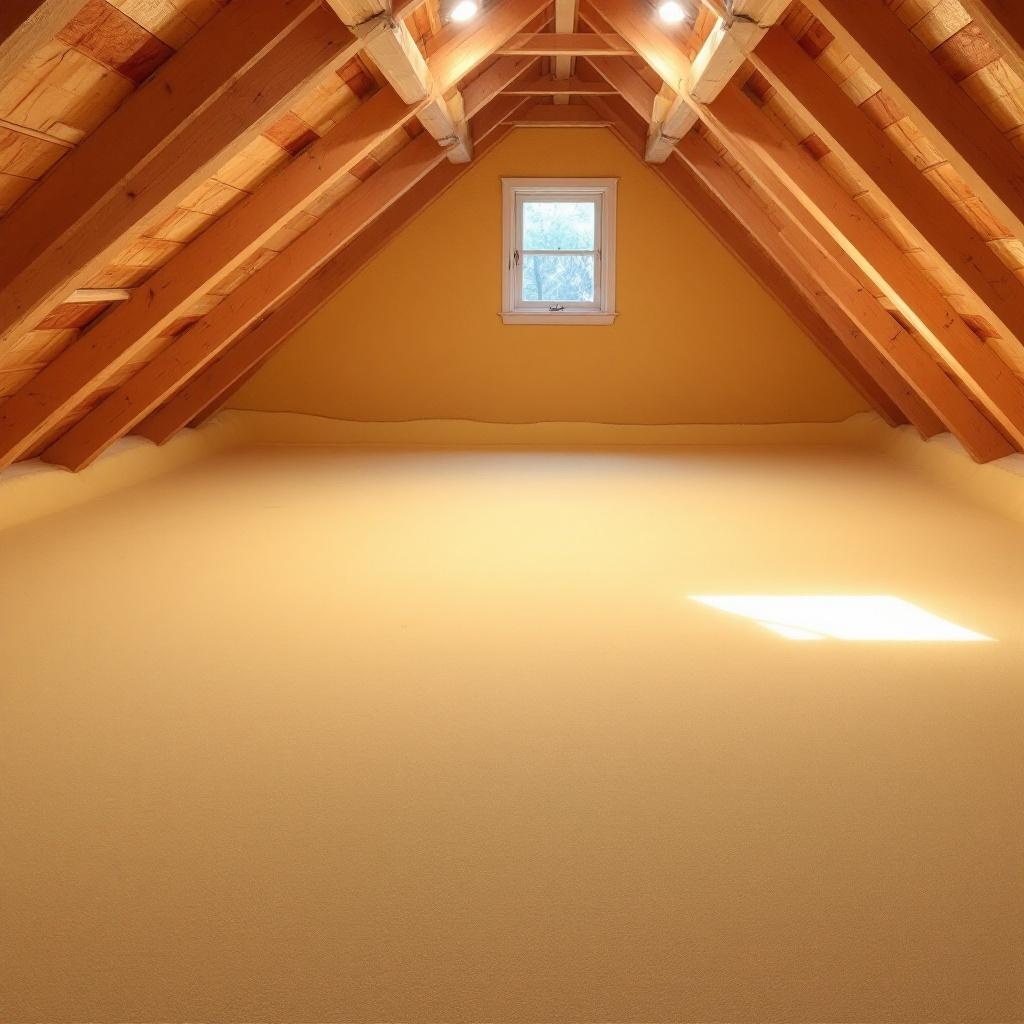
If ductwork or a furnace sits in the attic, foam the underside of the roof deck so that equipment ends up inside the insulated space. If the attic holds nothing but framing, air-seal the attic floor and insulate there.
Many Central Ohio two-stories built from the 1990s on, especially in Dublin, Powell, Lewis Center, and Westerville, have a second-floor air handler or flex duct running through the attic. Insulating the floor beneath that equipment leaves it working in a space that can fall toward the 5 degree Columbus winter design temperature, so every duct leak becomes a direct loss. Moving the insulation up to the roof deck creates an unvented attic, which the Residential Code of Ohio permits under section 806.5 with conditions, including foam in direct contact with the sheathing and, in Climate Zone 5, a Class II vapor retarder rating. If the attic has no mechanical equipment, the floor is cheaper: seal the top plates, wire holes, and fixture boxes, then build depth to R-49 with foam or blown fill. The roof deck moisture FAQ covers what keeps the roof deck approach safe here.
BPI-credentialed spray foam installs across Central Ohio since 2019. Mon-Fri 7am-6pm · Sat 9am-3pm.